
How to Use the Solana Holder Bot — Increase Your On-Chain Holder Count Automatically
Holder count is one of the first things traders check. Before looking at the chart, before reading the description — they glance at the number of holders. A token with 2,000 holders tells a completely different story than one with 50. It signals distribution, community, and staying power. Low holder count screams "one guy and his friends."
The Solana Holder Bot on Alphecca Tools automates holder generation. It creates new wallets, buys your token from each one, and the tokens stay in those wallets — directly increasing your on-chain holder count.
Why Holder Count Matters
DEX platforms and token scanners display holder count prominently. It's one of the fastest ways traders filter tokens:
Social proof at a glance. A token with thousands of holders looks established. A token with dozens looks like it hasn't been discovered yet — or worse, that people discovered it and left.
Trending algorithm input. DexScreener, Birdeye, and GeckoTerminal all factor holder count into their ranking logic alongside volume and maker count. A token with strong volume but 40 holders looks suspicious. Balanced metrics across volume, makers, and holders is what gets tokens surfaced.
Investor due diligence. Anyone considering a larger position will check holder distribution. A healthy holder count suggests the token isn't concentrated in a few wallets, which reduces perceived rug-pull risk.
Assets locked per holder wallet
Each holder wallet locks the following assets on-chain. All of them are fully recoverable — nothing is permanently spent:
| Asset | Amount | Recoverable |
|---|---|---|
| Token | Your buy amount worth of tokens | Via Multi Collector or Bundle Sell |
| SOL (system rent) | 0.00089088 SOL | Via Multi Collector |
| ATA Rent | 0.00203928 SOL | Via Batch Reclaim ATA Rent |
| PDA Rent (Pump.Fun only) | 0.0018444 SOL | Via Batch Pump PDA Recovery |
PDA Rent only applies to Pump.Fun tokens. For all other DEXs, the first three rows are the total cost per wallet.
How the Holder Bot Works
- The bot creates a new wallet and downloads the key pair
- Transfers SOL from your payment wallet to the new wallet
- Buys your token from the new wallet
- Tokens remain in the new wallet — this wallet is now a holder
- The wallet retains 0.00089088 SOL (system account rent-exempt minimum) to stay active on-chain
- Remaining SOL is sent back to your payment wallet
- Repeats for the next holder
The generated wallets are real on-chain addresses holding your token. Anyone checking holder distribution on Solscan or Birdeye sees these as independent wallets with balances.
Failed transactions aren't charged. Due to the atomic execution of Jito Bundles, if a swap fails, no service fee or gas is deducted. The bot moves on to the next one.
Save the wallet list. The holder bot automatically downloads the generated wallet key pairs. Keep them — you'll need them to sell the tokens at the right time, use the wallets for market making, or reclaim all remaining SOL, tokens, and deposited rent when the project ends.
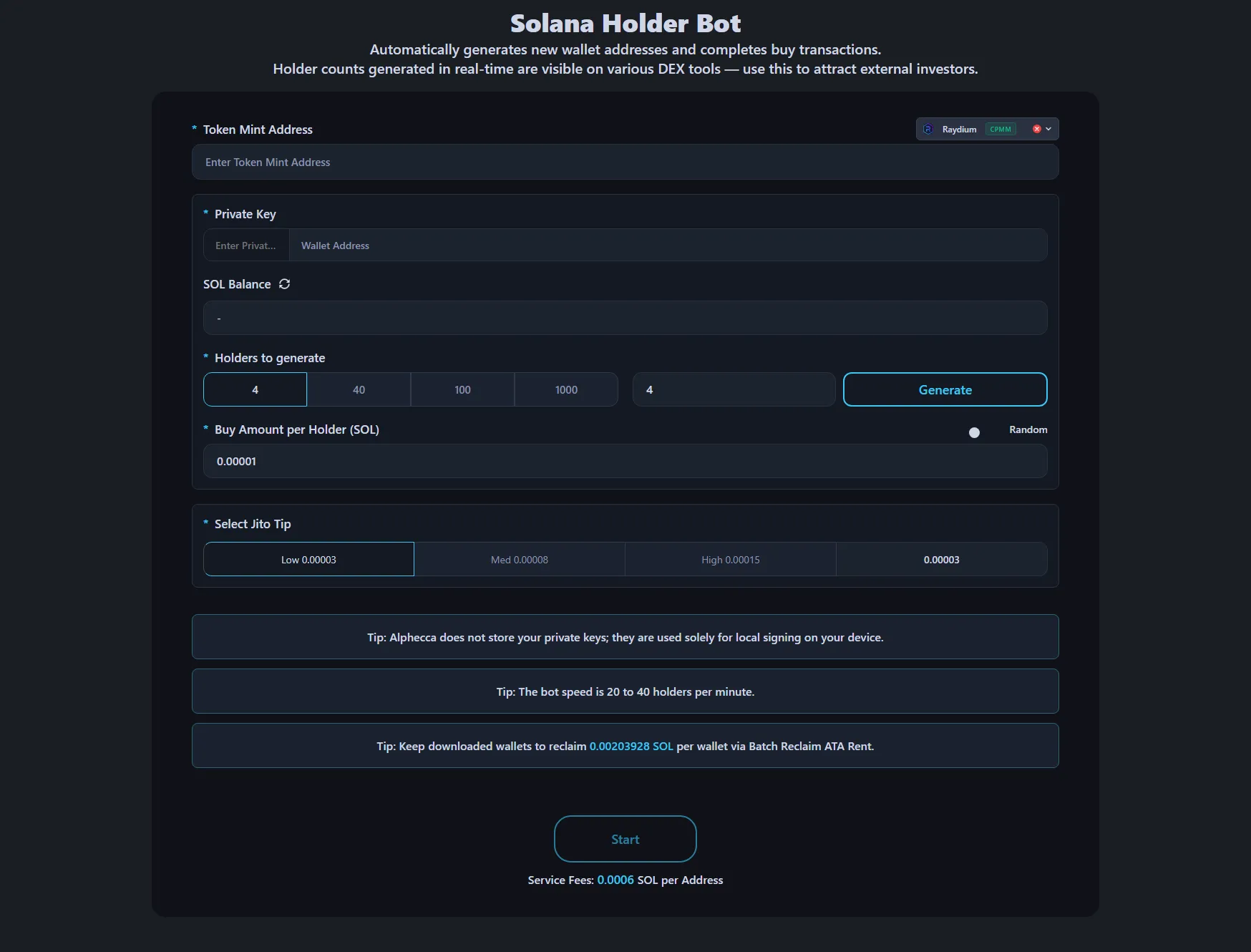
Configuring for Maximum Impact
Buy Amount Strategy
Each holder wallet buys a small amount of your token. The amount matters for two reasons: it contributes to trading volume, and it determines how the holder distribution looks on-chain.
Use the Random button. Identical buy amounts across hundreds of wallets is an obvious pattern. A randomized range — even something like 0.005 to 0.02 SOL — makes each holder look like an independent buyer who found your token at a different time with a different budget.
Don't go too low. The minimum is 0.00001 SOL, but holders with dust-level balances look suspicious to anyone scanning the distribution. Slightly larger amounts look more like real people who actually wanted to hold the token.
Holder Count Planning
Check comparable tokens in your niche. If similar market-cap tokens have 1,000–3,000 holders, that's your target range. Showing up with 10,000 holders on a micro-cap token looks as unnatural as having 20.
Build in batches over time. Running 2,000 holders in one burst creates a visible spike in holder growth charts. Spreading it across multiple sessions over days looks like organic adoption — a steady upward curve rather than a vertical line.
Jito Tips
The minimum is 0.000001 SOL, and that's enough for most situations. Transactions land reliably at the lowest tip. Only increase it if you're seeing frequent failures during extreme network congestion.
For step-by-step parameter details and technical setup, see the Holder Bot Documentation.
What to Do with Tokens in Holder Wallets
Even after the holder bot finishes, your tokens are still sitting in those wallets — they're your assets, and you have full control over them with the downloaded key pairs. Here's what you can do with them.
Use holder wallets for market making. Instead of leaving the wallets idle, import them into the market making bot as trading wallets. This turns your existing holder wallets into active chart participants, generating natural-looking volume and price action from wallets that already hold your token.
Sell in bulk. Once collected, use Bundle Sell to sell the tokens in a single bundled transaction — no need to manually sell from each wallet.
Collect tokens into one wallet. Use the Multi Collector to gather all tokens from your holder wallets into a single wallet for selling or other purposes.
Reclaim all rent after the project ends. Close the accounts and recover all on-chain deposits — 0.00203928 SOL (ATA rent) per wallet, plus 0.0018444 SOL (PDA rent) per wallet for Pump.Fun tokens. Use Batch Reclaim ATA Rent and Batch Pump PDA Recovery.
Combining Holder Bot with Other Tools
Holder count alone doesn't make a token trend. It's one piece of the puzzle.
Holder Bot + Maker Bot: Both buy from new wallets with the same price impact. The maker bot is cheaper per wallet because it auto-reclaims all rent and returns tokens to you — but it only increases maker count. The holder bot costs more per wallet but increases both maker count and holder count. Use the maker bot for pure maker growth, holder bot when you need distribution.
Holder Bot + Volume Bot: The volume bot is the simplest and most cost-effective way to keep transaction count flowing. It generates high-frequency trades with minimal configuration and low cost per transaction, keeping your token visible on DEX aggregators. Build your holder base first with the holder bot, then let the volume bot maintain steady activity on autopilot.
Holder Bot + Market Making Bot: The market making bot gives you full control over how your chart looks — choose the direction, pace, and intensity of price movement to create exactly the chart pattern you want. Holder count gets people to click on your token, but the market making bot ensures what they see is a natural, healthy chart worth buying into.
Recommended sequence:
- Run holder bot to build target holder count
- Run maker bot to build maker count
- Start volume bot for cost-efficient sustained transaction activity
- Layer on market making bot to shape the chart exactly how you want it
- Launch marketing when all metrics look healthy
Holder Bot vs Maker Bot — What's the Difference?
Both bots create new wallets and buy your token with the same buy amount, so both increase maker count and create the same upward price pressure. The difference comes down to two things: where the tokens end up, and the cost per wallet.
Maker bot: Buys → sends tokens back to your main wallet → automatically closes the ATA account and reclaims 0.00203928 SOL rent. For Pump.Fun tokens, it also closes the PDA account and reclaims an additional 0.0018444 SOL. This means maker count increases while holder count stays unchanged, and all SOL, tokens, and rent are fully returned from the maker wallet, leaving it completely empty.
Holder bot: Buys → tokens stay in the new wallet. The ATA account stays open because the wallet is holding tokens. A small amount of SOL (0.00089088 SOL for system account rent-exempt minimum) also remains in the holder wallet to keep it alive on-chain. This means both maker count and holder count increase, but the tokens are distributed across generated wallets instead of returned to you.
The maker bot is cheaper per wallet — it automatically recovers all rent, while the holder bot leaves rent locked until you reclaim it later via Batch Reclaim ATA Rent (and Batch Pump PDA Recovery for Pump.Fun tokens).
Choose based on what you need: Maker bot for pure maker count with tokens and rent returned to you. Holder bot when you specifically need to increase on-chain holder distribution.
Cost Structure
The holder bot charges a flat service fee per holder. You also pay the buy amount per holder, plus a few on-chain deposits required by Solana's account structure. Understanding how these deposits work helps you plan your budget — and know exactly what you can recover later.
Where does the cost per wallet come from?
Every wallet on Solana needs a small SOL deposit to be recognized as an active account on-chain — this is the minimum balance required for DEX tools like DexScreener and Birdeye to count it as a holder. This is called the rent-exempt minimum (0.00089088 SOL).
On top of that, holding a token requires a separate account called a Token Account (ATA) — this is where the token balance actually lives. Creating one locks another 0.00203928 SOL as a deposit.
For Pump.Fun tokens, there's one more: a Volume Accumulator PDA that Pump.Fun's program creates automatically when a wallet trades. This locks an additional 0.0018444 SOL.
None of these are fees — they're all deposits you get back. When the project ends and you no longer need the holder wallets, close the accounts and every last lamport of rent comes back to you.
Budget calculation: holder count × (buy amount + service fee + Jito tip + 0.00203928 SOL ATA rent + 0.00089088 SOL system rent + 0.00001 SOL) + 0.0075 SOL reserve. For Pump.Fun tokens, add holder count × 0.0018444 SOL (PDA rent) to the total.
Failed transactions aren't charged — you only pay for successful ones.
FAQ
How fast can I generate holders?
Direct DEX swaps produce 15–30 holders per minute. Jupiter swaps are slightly slower at 10–20 per minute.
Do the holder wallets actually hold tokens?
Yes. Unlike the maker bot which sends tokens back to your main wallet, the holder bot leaves tokens in each generated wallet. These wallets are real on-chain holders with a small SOL balance to keep them active.
Can I recover the SOL from holder wallets?
Yes. Keep the downloaded wallet key pairs. After the project ends, use Batch Reclaim ATA Rent to recover 0.00203928 SOL per wallet. For Pump.Fun tokens, additionally use Batch Pump PDA Recover for 0.0018444 SOL per wallet.
What happens if a transaction fails?
The bot skips it and continues. No service fee or gas fee is charged for failed transactions.
Does this work with SPL 2022 tokens?
No. SPL 2022 Program tokens are not currently supported. Standard SPL tokens on Pump.Fun, Raydium, Jupiter, and other major Solana DEXs work normally.
How many holders should I target?
Check tokens with similar market caps in your niche. Match or slightly exceed their holder count. Wildly exceeding comparable tokens looks unnatural — aim for credible numbers that fit your token's stage.
Should I run holders all at once or in batches?
Batches over multiple days. A sudden jump from 50 to 2,000 holders in one hour shows up as an obvious spike on holder growth charts. Gradual growth across sessions looks like organic adoption.