
How to Create Arbitrum ERC-20 Custom Token (2026)
Let's explore how to create a powerful ERC-20 token on the Arbitrum blockchain without any programming knowledge. Alphecca's Arbitrum Token Creator offers an intuitive interface with various custom features, enabling professional token deployment in under a minute for just 0.01 ETH.
This dApp fully complies with the Arbitrum (ERC-20) standard, designed to solve Ethereum's scalability issues, known for low fees and fast processing speeds. Beyond simple token creation, you can freely configure detailed options to match your project's characteristics.
Let's walk through the step-by-step process to create a feature-rich Arbitrum token.
How to Create an ERC-20 Token on Arbitrum?
ERC-20 is a technical standard for establishing fungible assets on Arbitrum. Arbitrum ensures low gas fees and ultra-fast transaction processing while inheriting Ethereum's security through Optimistic Rollup technology with approximately 0.25 second block times.
The Arbitrum blockchain is an Ethereum Layer 2 solution that allows you to create tokens and NFTs at lower gas costs while maintaining full compatibility with Ethereum. Anyone can deploy a smart contract following the ERC-20 standard to create their own token.
Why Create an ERC-20 Token on Arbitrum?
The Arbitrum chain provides overwhelmingly lower gas fees and faster processing speeds compared to Ethereum mainnet through Optimistic Rollup technology. Inheriting Ethereum's security while offering years of proven stability and a massive DeFi ecosystem makes it an attractive choice for developers looking to launch tokens on a new blockchain.
Tokens created on Arbitrum can be used for:
- Payment Currency: Payment method optimized for low fees
- Contract Execution: Low-cost execution of Ethereum-compatible smart contracts
- Exchanges: Liquidity provision and trading on decentralized exchanges (DEX)
- Governance: Voting rights to determine project direction
- Stake: Network contribution and rewards through staking
- DeFi: Utilization in the growing Arbitrum DeFi ecosystem
How Much Does It Cost to Create an Arbitrum Token?
To launch a token on the Arbitrum blockchain, you need a smart contract that controls the token's behavior on the blockchain. This is essentially a digital agreement and program code, requiring professional programming knowledge to write from scratch.
The problem is cost. Hiring a professional developer for contract creation typically incurs high outsourcing costs of $300 or more. Such expenses can be a barrier to entry in the early stages of a project.
Alphecca provides an online solution allowing anyone to issue tokens without coding, lowering these technical and economic barriers. You can instantly create your own token for a reasonable cost of just 0.01 ETH, creating an environment where users lacking funds or technical skills can freely participate in the cryptocurrency ecosystem.
Using the Arbitrum Token Creator dApp eliminates the complex coding process. Smart contracts are automatically generated with just a few clicks, and professional-grade token deployment is completed for 0.01 ETH.
Step-by-Step Guide to Creating an Arbitrum Token
To create a token on the Arbitrum chain, go to Alphecca Tools' Arbitrum Token Creator (https:/
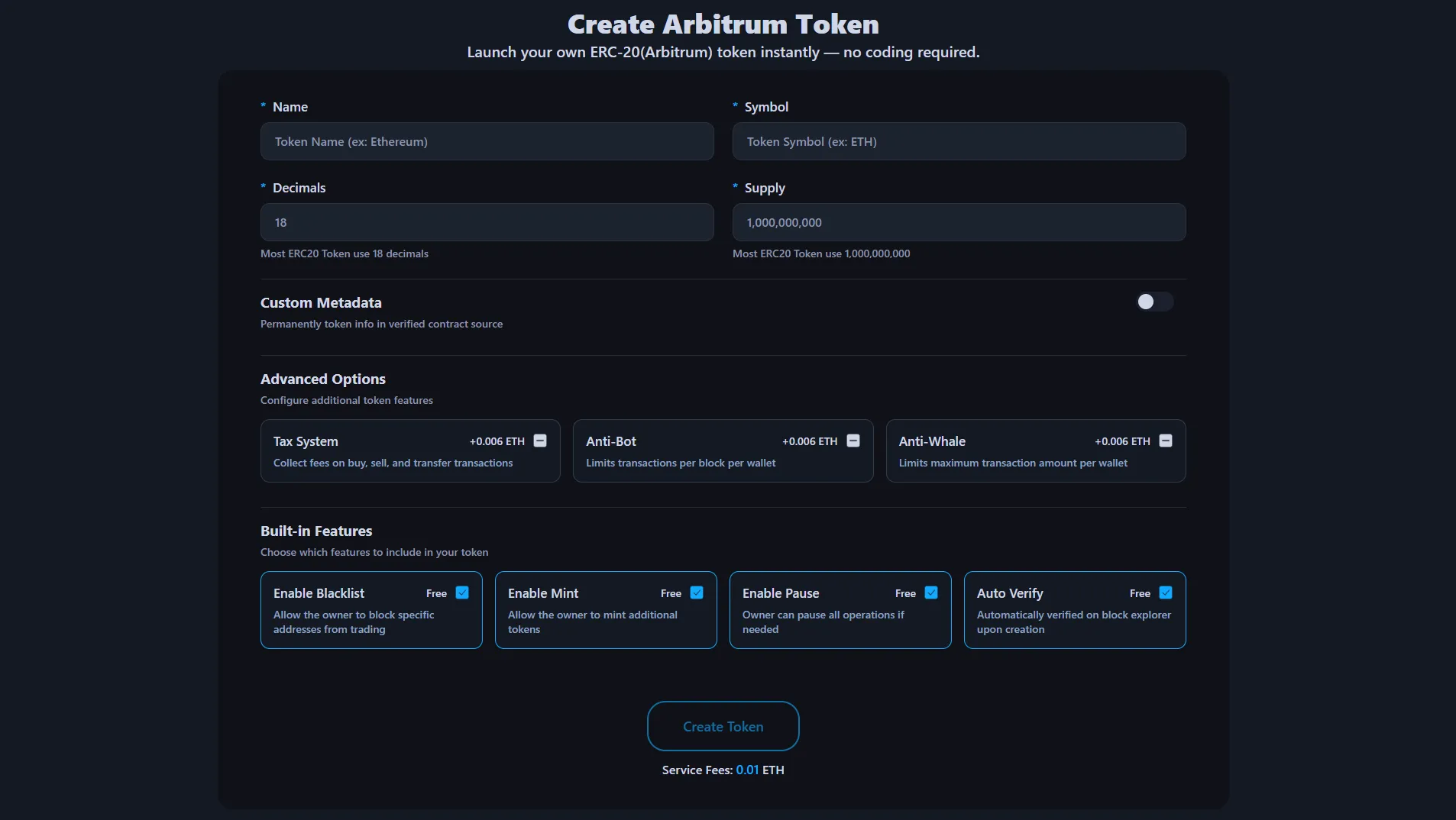
- Connect your wallet
- Enter the name and symbol for your token
- Enter the token description and SNS information that will be displayed in the contract source code
- Define the decimals and supply of your token
- Click Create Token, approve the transaction, and wait for the token to arrive in your wallet
This tool supports advanced options essential for project operation, including tax settings, anti-bot, and anti-whale.
The "Tax System" allows you to impose tax rates on buys, sells, and transfers, and designate a wallet address to receive fees.
"Anti-Bot" limits the number of transactions a wallet can make per block, preventing sniper and bot activity in liquidity pools. You can also set the anti-bot activation duration, useful for protecting your token from mass trading at launch start.
"Anti-Whale" allows you to set buy/sell limits per transaction for a single wallet, time limits between buy/sell transactions, and maximum holding limits per wallet. You can also set the anti-whale activation duration, useful for protecting your token from large trades at launch start.
- Once tax, anti-bot, and anti-whale features are activated, settings can be changed for free.
Additionally, this tool supports the following core features at no extra cost during token creation.
"Metadata Settings" displays not only the token name and symbol but also your custom token description and SNS information in the source code when searching the token address on Arbiscan.
"Blacklist" is a feature that blocks all token activity from specific wallets. You can add or remove addresses from the blacklist to block malicious traders or bots from trading your token.
"Additional Token Minting" allows you to mint additional tokens after contract creation to increase the total supply and immediately transfer minted tokens to a designated wallet.
"Token Pause" can temporarily halt all token activity and can be reactivated after resolving emergency situations or security issues.
"Auto Token Verification" automatically verifies the source code on Arbiscan immediately after token creation without manually authenticating the contract code, granting a verification badge.
- Blacklist, additional minting, and pause features can be modified for free once activated.
Next Step: List Your Token on Decentralized Exchanges (DEX)
After deploying your ERC-20 smart contract through Alphecca Tools' Arbitrum Token Creator, it's time to create a liquidity pool on a decentralized exchange (DEX). You can officially launch your newly created token on the market by pairing it with major assets like $ETH or $USDC. Alphecca fully supports major DEXs on Arbitrum including Uniswap, Camelot, and SushiSwap, and supports both versatile V2 pools and V3 for more sophisticated liquidity management.
Token Information Site Registration
Once you create a liquidity pool, your token automatically appears on DexScreener, GeckoTerminal, and DEXTools. No separate application needed - it's displayed immediately when trading occurs.
CoinMarketCap and CoinGecko require separate applications, and registration is free.
- CoinMarketCap Application
- CoinGecko Application
To maintain high DEX rankings after registration, refer to the Arbitrum Volume Bot Usage Guide.
Essential Considerations When Creating Arbitrum Tokens
For a successful token launch, operational strategy is as important as technical deployment. Make sure to check the following before issuance.
-
Tokenomics Design: Carefully determine your token's total supply and distribution plan. Clearly designing initial liquidity supply, team holdings, and marketing and ecosystem reward ratios will build trust with investors.
-
Securing Initial Liquidity: For smooth trading after token issuance, you need to provide sufficient liquidity to decentralized exchanges (DEX). Insufficient liquidity can cause excessive price volatility even at low trading volumes, making it difficult for users to enter.
-
Security and Contract Verification: Investors prefer secure assets. Using Alphecca Tools automatically verifies your source code on Arbiscan, allowing you to establish transparency instantly without complex procedures. This is the most basic step in building project credibility.
-
Continuous Community Management: Maintaining a token is more important than issuing it. Communicate consistently with investors through social channels like Telegram, Twitter (X), and Discord. Registering social media links on Arbiscan is the first step of that communication.
Final Conclusion on Creating Arbitrum Tokens
Issuing your own ERC-20 token on the Arbitrum blockchain goes beyond simple asset creation - it's leaving a unique footprint in a stable Ethereum Layer 2 ecosystem that inherits Ethereum's security. It's also a crucial means for project owners and developers to build trust and communicate with communities and investors. Ultimately, for those seeking to create value and seize greater opportunities in the Web3 space, token issuance is an important turning point from being a simple user to becoming an ecosystem architect.
Now anyone can create an Arbitrum token in just a few minutes through automatic smart contract generation tools without complex programming knowledge. With technical barriers removed, we encourage you to turn your ideas into reality.
Thank you for reading.